Organizing C++ Module Sources
After having worked with C++ modules using the Microsoft compiler with Visual Studio for quite a while now, I think I’ve finally found a useful structure for organizing the source tree with modules.
Previously, we had a rather flat tree for the sources of our UML Editor, which was difficult to navigate.
We have ~40 packages. For each of these we have a directory and a project in Visual Studio.
Single module with partitions
We have for example a package Core. It defines a single C++ module and a
C++ namespace with the same name.
The Core module is further structured into
module partitions.
The primary interface of the Core module looks like this (file
Core/_Module.ixx):
export module Core;

export import :Attach;
export import :Base;
export import :Container;
export import :Diagram;
export import :Interfaces;
export import :Transaction;
export import :View;
It contains the partitions Attach, Base, Container, etc.
The source files for a specific partition are now grouped together into a dedicated
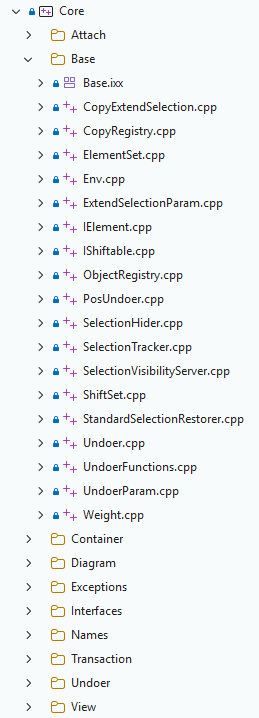
sub-directory. Here is a screenshot of the Base partition in Visual Studio
Explorer:
The file
Core/Base/Base.ixx
contains the declarations of the types in the Base partition.
It has the line:
export module Core:Base;
The (member-) functions declared in Base are then defined in several *.cpp files
in the same directory.
For example the file Core/Base/IElement.cpp contains the lines:
module Core:Base.IElement;
import :Base;
This is an internal partition compliant with the C++ standard. To compile this with
the MSVC compiler, the compiler flag
/InternalPartition
must be set.
Partitions do not implicitly import any other partitions or modules. Specifically,
the interface partition :Base is not implicitly imported and thus needs to be
explicitly imported.
The name of the internal partition (:Base.IElement) is not used anywwhere else.
It must be unique within the module. This internal partition only serves as a
place for defining functions of the :Base partition. See my
posting
“The Module Partition Naming Trick”
for why we use this pattern.
The file names of the files are not relevant. Module and partition names are found during the scanning process when compiling.
Having all files that are needed for a partition inside a single, distinct sub-directory, has proven to be helpful. The files of a partition can now be found at a single place.
Unfortunately, there currently is a caveat though: The compiler emits files that
are produced by the compilation, like for example the .ifc files, to the
same output directory. If two partitions use the same name for their .ixx file,
the output file names will clash when building with MSBuild. Luckily, MSBuild warns
about this:
1>...\MSBuild\Microsoft\VC\v180\Microsoft.CppBuild.targets(1142,5):
warning MSB8027: Two or more files with the name of Base.ixx will produce outputs
to the same location. This can lead to an incorrect build result.
The files involved are Base\Base.ixx, Diagram\Base.ixx.
Note that the MSVC compiler for example recompiles only the cpp-files belonging
to the Transaction partition, if the interface file Core/Transaction/Transaction.ixx
is changed. The cpp-files in other partitions of the Core module are only recompiled,
if they explicitly import :Transaction.
Partitions aren’t visible to the users of the Core module. It can only be
imported has a whole.
Advantages of using partitions are:
- Partitions provide a means to split large module interfaces into multiple parts.
- The module can internally use forward declarations of classes across partitions.
- If an interface partition is changed, only files that directly or indirecty import it need to be recompiled.
I’ve published an updated partial snapshot of the sources on github.
Several modules
A second kind of package contains just a number of (sub-) modules, with a subdirectory per module.
An example for such a package is our
GraphUtil
package.
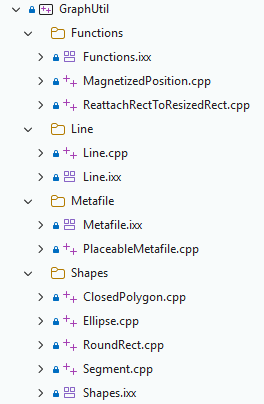
It contains the modules:
GraphUtil.FunctionsGraphUtil.LineGraphUtil.MetafileGraphUtil.Shapes
The dot in the name of those modules doesn’t convey a special meaning to the compiler. The C++ standard just allows to use period characters in module names, which can be used for grouping names.
Lots of small modules
A third kind of packages contains just the files without using further
sub-directories. We have used that for basic infrastructure packages like
d1
and
WinUtil,
which contain lots of small modules.
(last edited 2026-04-09)